THESE AREN’T JUST BIG GARDEN COMPOST HEAPS
This is industrial-scale open windrow composting
Green waste would be piled into enormous outdoor rows, commonly around 8m wide, 4m high and 40m long.
Forming massive heaps that are repeatedly turned by heavy clattering machinery as tonnes of organic waste heat, smell, decompose and break down.
These are not passive garden compost heaps.
In addition, the application gives no indication of how many windrows may be operating simultaneously at any one time. Consequently, the cumulative generation of heat, moisture, odour, dust and bioaerosols from multiple active windrows has not even been considered or assessed within the application.
INDUSTRIAL WINDROWS GENERATE HUGE AMOUNTS OF HEAT, MOISTURE, ODOUR, DUST, BIOAEROSOLS
AND THE CONDITIONS IN WHICH FLIES, GULLS, RODENTS AND OTHER VERMIN CAN THRIVE – AS PART OF THE COMPOSTING PROCESS ITSELF.
EVERY DAY.
SEVEN DAYS A WEEK.
52 WEEKS OF THE YEAR.
Those emissions do not simply remain where they are produced — nor do they stop at a conveniently predetermined boundary of 250 metres.
THE BIOLOGICAL PROCESS DOES NOT STOP THERE.
This summer, the remarkable increase in fly numbers has attracted widespread media attention and become a regular topic of conversation across the country.
It is also a timely reminder that industrial composting does not simply generate heat, moisture, odour, dust and bioaerosols. It also creates the conditions in which flies, gulls, rodents and other vermin can thrive.
This is not conjecture.
It is a recognised and well- documented consequence of large-scale open windrow composting.
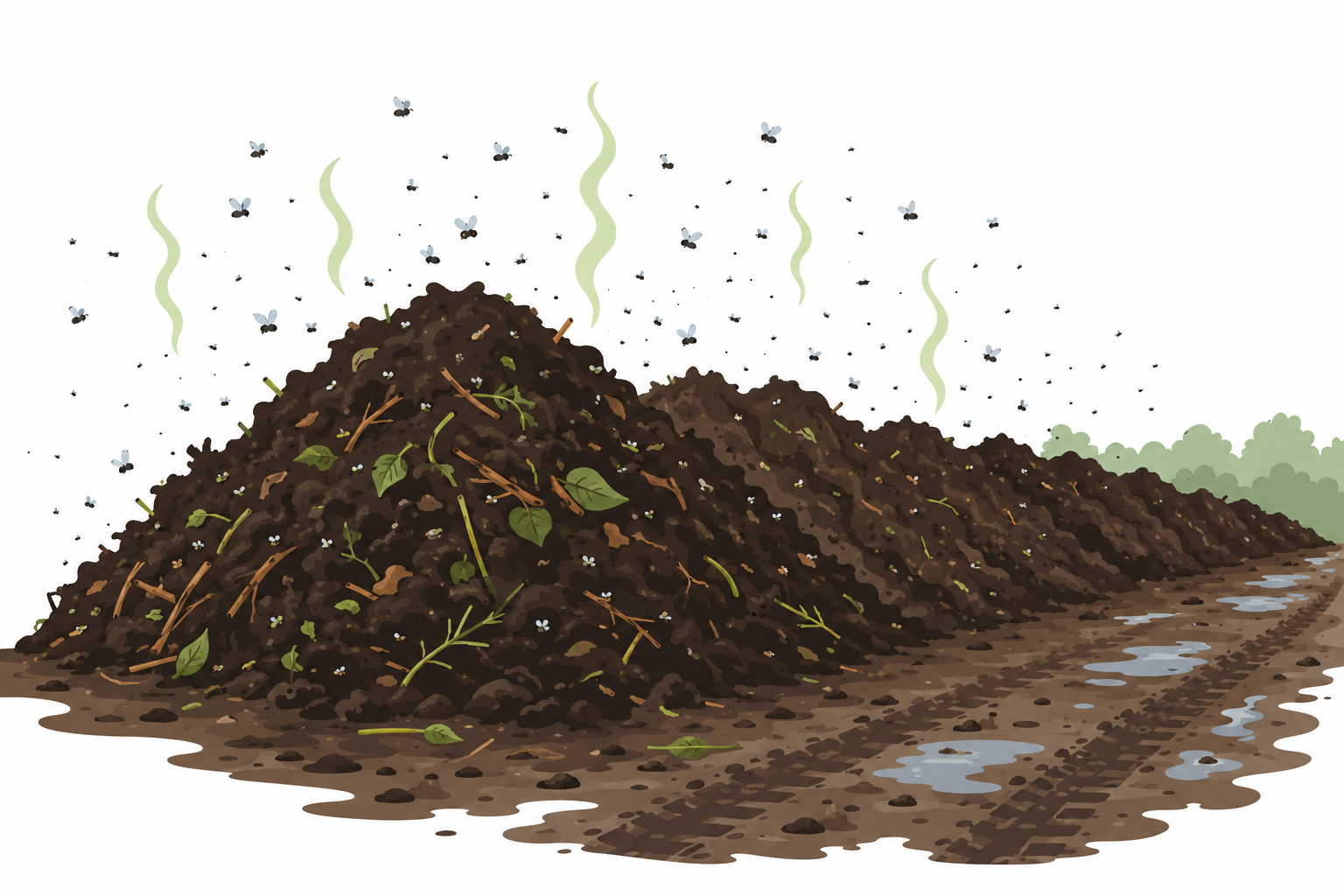
Industrial Composting Windrow (Illustrative)
The Environment Agency requires commercial composting operators to monitor and control flies and other pests, not because they are unusual, but because uncontrolled infestations can become a public nuisance, an amenity issue and, in some circumstances, a public health concern.
Flies do not create the problem. They reveal it.
They are one of the most visible signs of a biologically active industrial waste process taking place in the open air.
BUT IT IS NOT ABOUT ONE NUISANCE.
IT IS ABOUT THE CUMULATIVE CONSEQUENCES OF PLACING A BIOLOGICALLY ACTIVE INDUSTRIAL WASTE PROCESS.
IMMEDIATELY ABOVE HOMES, FOOD-PRODUCING FARMLAND AND THE ROSEWORTHY VALLEY.
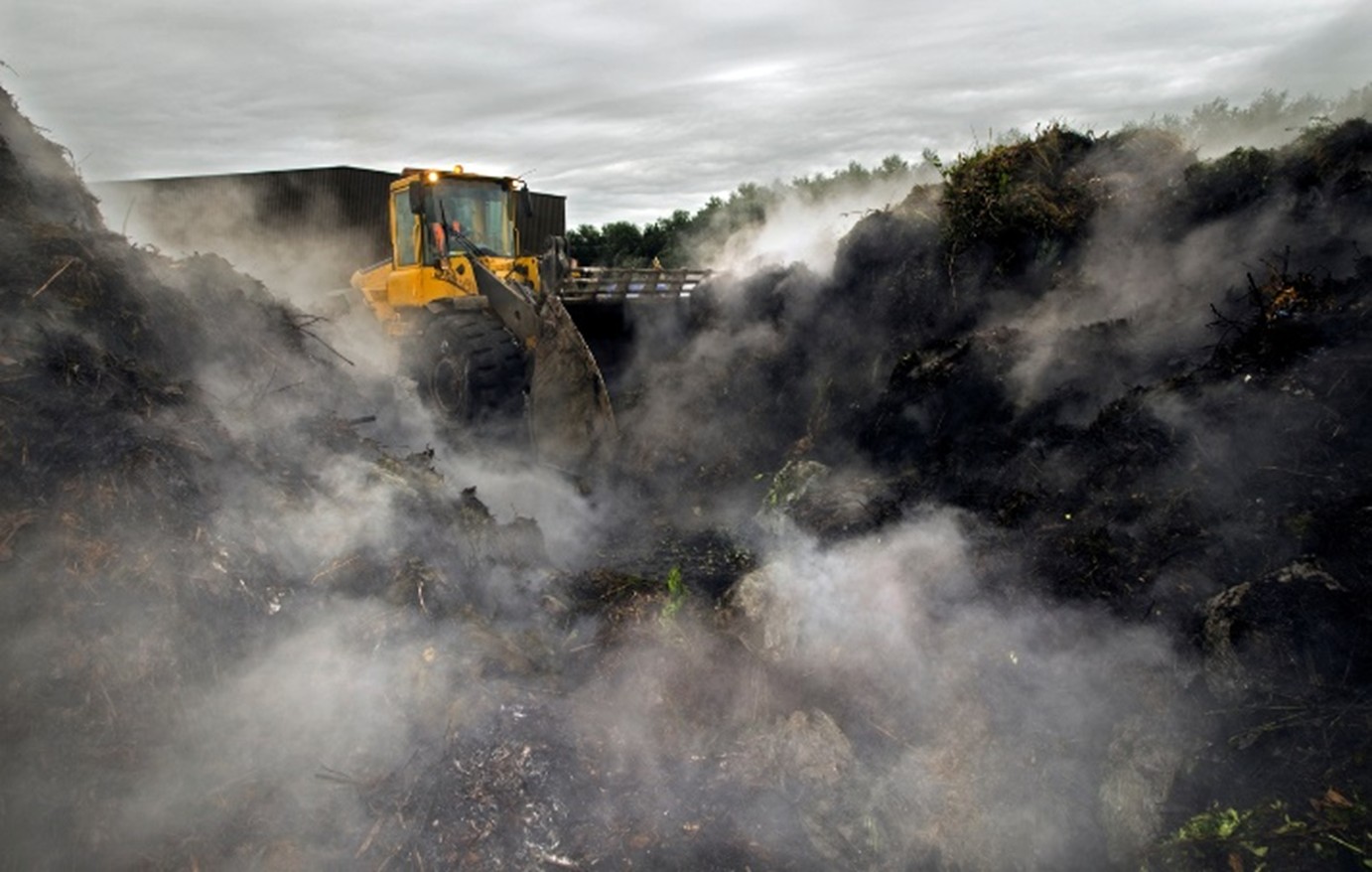
Industrial Composting (Illustrative)
The scale is industrial.
The procedure is mechanical.
The process is biologically active.
The impacts extend beyond the site
INDUSTRIAL COMPOSTING IS NOT THE ISSUE.
Putting it here is.
Location changes everything.
AND IT ALL HAPPENS IN THE OPEN AIR ON AN EXPOSED AND WINDY HILLTOP ABOVE THE ROSEWORTHY VALLEY…