THIS IS THE ONLY WAY IN AND OUT OF THE APPROVED INDUSTRIAL WASTE SITE…
What could possibly go wrong?
Immediately beside the entrance stands a live Pressure Reduction Station (PRS) operated by Wales & West Utilities.
An intermediate-pressure gas main runs from the PRS across the development site.
The photographs below make the starting point impossible to miss.
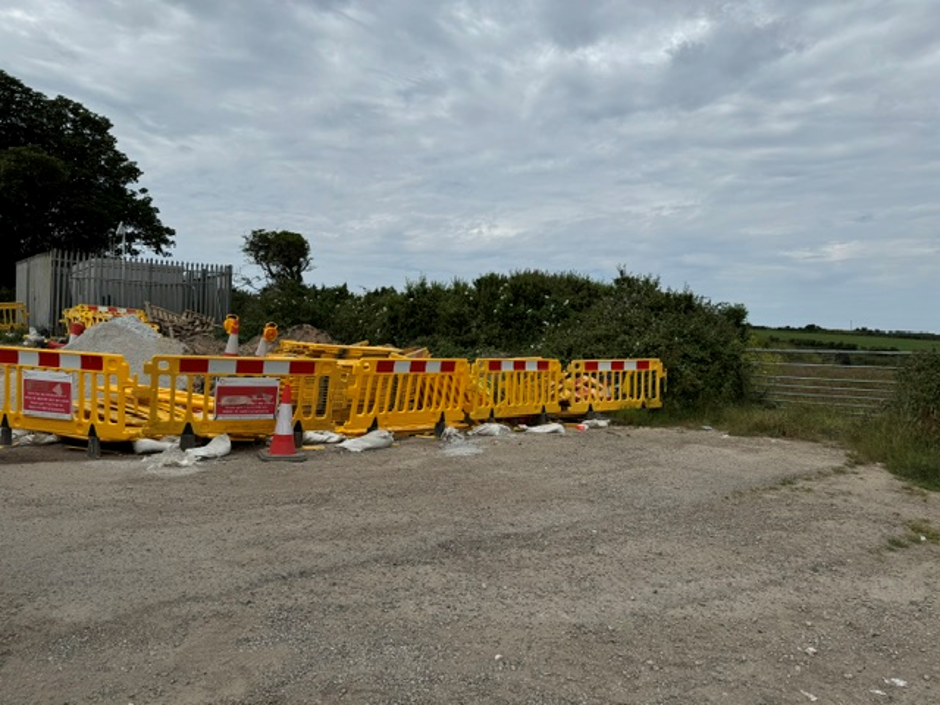
Sole access to Site is via a public lay-by, adjacent to the PRS owned by Wales and West Utilities
A PRS is a critical part of the gas distribution network. It reduces gas from a higher pressure to a lower pressure so that it can continue safely through the network supplying homes and businesses
Connected to it is a live intermediate-pressure gas main.
That main runs from Roseworthy Hill, across the public lay-by, beneath the existing entrance and across the development site.
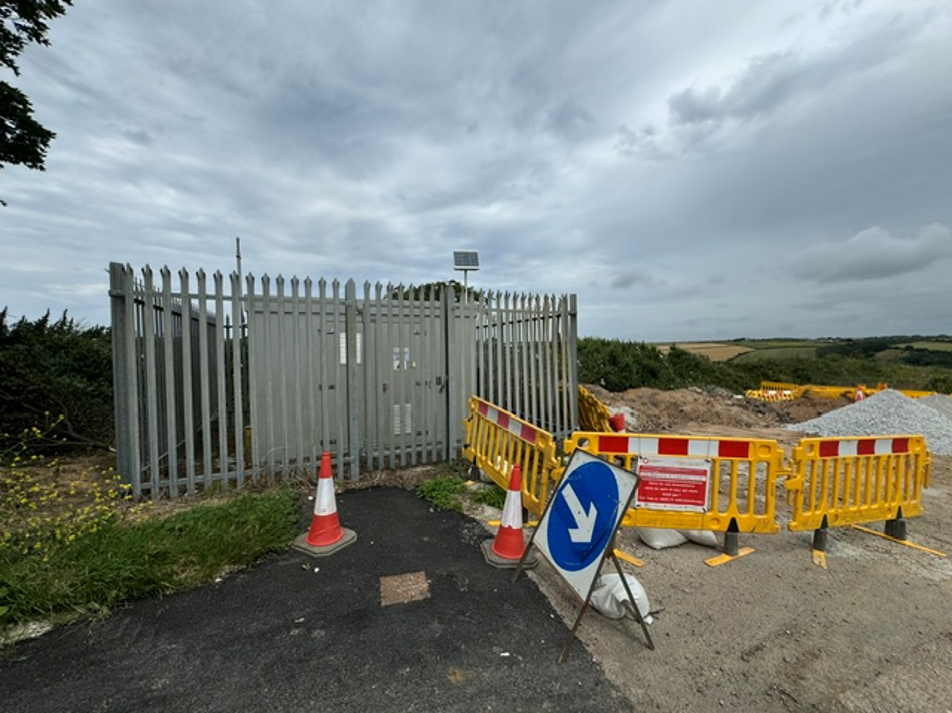
Wales and West Utilities PRS undergoing maintenance next to Site access
To enable HGVs to manoeuvre, the site entrance itself is to be widened by a further two metres.
The hazard warning displayed on the PRS could hardly be clearer.
It reads:
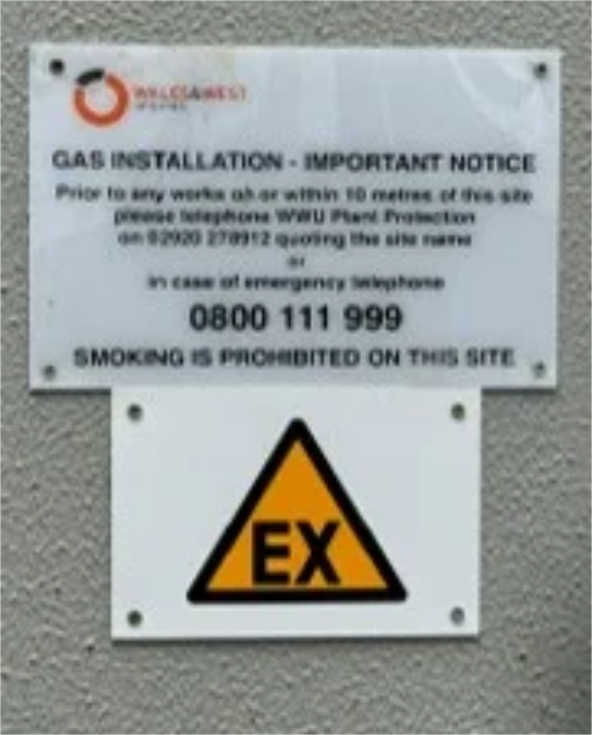
“Prior to any works on or within 10 metres of this site please telephone WWU Plant Protection.”
“SMOKING IS PROHIBITED ON THIS SITE.”
Directly beneath those words is the recognised EX explosive-atmosphere warning symbol.
THIS IS NOT GAS INFRASTRUCTURE SOMEWHERE BEYOND THE DEVELOPMENT BOUNDARY.
It sits immediately on the site’s doorstep, beside the only entrance to the site, where tens of thousands of construction and operational HGV movements will occur annually. It lies beneath the access. And across the site.
THE PIPELINE RUNS ALONG THE HIGHER SIDE OF THE HILL
The applicant’s own Atkins engineering drawings identify an:
“EXISTING INTERMEDIATE PRESSURE GAS MAIN.”
Those drawings show it running along the western, highest part of the development land. From there, the hillside falls sharply eastwards through the proposed operational area.
That relative position matters.
The approved scheme does not simply place a building somewhere near a gas pipeline.
It proposes major cut-and-fill engineering immediately downhill from it.
The applicant’s own calculations identify approximately:
- 22,511 cubic metres of excavation;
- 27,134 cubic metres of fill;
- across almost 3.3 hectares of newly engineered ground.
The hillside is to be excavated by up to approximately 2.5 metres, with material moved, deposited at lower levels, compacted and then loaded with a vast concrete platform, buildings, machinery, waste stockpiles, HGVs and millions of litres of stored, recycled and dirty water.
The obvious safety question is not simply whether an excavator might strike the buried pipeline.
It is also this:
WHAT HAPPENS TO THE SUPPORT AND STABILITY OF A LIVE GAS PIPELINE WHEN THE HILLSIDE IMMEDIATELY BELOW IT IS EXCAVATED, REGRADED, FILLED, COMPACTED AND HEAVILY LOADED?
And this is not known, simple or uncontaminated ground.
The submitted land contamination reports and Groundsure information identify the site’s former mining legacy and record potential cavities, mine workings and other subsurface hazards that cannot be ruled out, together with compressible deposits and running sands.
Right here.
YET THIS IS THE VERY HILLSIDE APPROVED FOR MAJOR CUT-AND-FILL ENGINEERING IMMEDIATELY ADJACENT TO LIVE PRESSURISED GAS INFRASTRUCTURE.
THE GAS NETWORK OPERATOR ALREADY IDENTIFIED THE RISK
Wales & West Utilities confirmed in writing that the live intermediate-pressure main runs:
“from the main road, Roseworthy Hill, across the lay-by into the site.”
It also confirmed that “the proposed access to the development will cross the IP Pipeline in the widened existing site entrance.”
Its formal planning response stated that it had “no objections to these proposals“, but immediately qualified that position by warning that its apparatus “may be at risk during construction works” and “may be directly affected by these proposals.”
It then stated unequivocally:
“You must not build over any of our plant or enclose our apparatus.”
Those words deserve careful attention.
MAY BE AT RISK.
MAY BE DIRECTLY AFFECTED.
MUST NOT BE BUILT OVER OR ENCLOSED.
WWU’S OWN SAFETY CONDITIONS GO MUCH FURTHER
The conditions attached to the WWU response require consultation before excavation within 10 metres of gas installations or pipelines.
They place explicit restrictions on mechanical excavation, piling, boring, hot works and the movement of heavy plant.
They say:
“No work shall be undertaken near, nor heavy plant or equipment moved over, any gas pipeline or apparatus until all of the conditions specified by WWU have been complied with.”
They require suitable crossing points where works cross or run close to gas apparatus.
They specifically require WWU engineer involvement in works affecting, or taking place near, its apparatus, together with continued access for inspection, maintenance and emergency works.
And for deep excavations of 1.5 metres or more, WWU says: “This may require the diversion of WWU apparatus prior to the commencement of your works.”
Yet the approved excavation reaches approximately 2.5 metres.
That is a full metre deeper than the level at which WWU’s own conditions say diversion may be required.
WWU also makes the financial consequence explicit:
“Should diversion works be required these will be fully chargeable.”
So this is not simply a question of placing protective matting over a pipe, or tarmacking the public lay-by and building over the existing gateway with a convenient new site access road.
The approved works may require:
- detailed engineering redesign;
- specialist protection;
- controlled crossing points;
- continuing WWU supervision;
- preservation of emergency access;
- and potentially diversion of the gas main itself.
A “MAJOR ACCIDENT HAZARD” WARNING
A 2019 WWU plan for the site area showing the gas infrastructure carries a red warning box stating:
“Extreme caution. Major Accident Hazard Pipeline in Vicinity. RISK OF DEATH OR SERIOUS INJURY.”
It instructs anyone proposing excavation to contact the Plant Protection Team before any works begin.
WWU’s separate working conditions provided to the Council expressly warn that even damage causing no immediate gas escape may result in a later failure of the pipeline.
This is why the risk cannot be reduced to a simple statement that the gas company did not formally object.
The same gas company warned that:
- its apparatus may be at risk.
- its apparatus may be directly affected.
- no heavy plant should move over the pipeline until all its requirements had been met.
- deep excavation may require diversion of the pipeline.
- any such diversion would be fully chargeable.
WWU’S LEGAL RIGHTS EXTEND FAR BEYOND THE PIPELINE
The gas main is also protected by a legal easement – a binding legal agreement that gives Wales & West Utilities continuing rights over the land to inspect, maintain, protect, repair, replace and, where necessary, divert the pipeline.
THE EASEMENT DOES NOT EXIST SOLELY TO PROTECT THE PIPELINE.
It protects Wales & West Utilities’ legal rights and apparatus across the affected land.
In this case, that includes the pressure reduction station (PRS), the intermediate-pressure gas main, access for inspection, maintenance and emergency works, together with the other rights and protections set out in the deed.
A PRESSURISED GAS MAIN TOGETHER WITH A CRITICAL PRESSURE REDUCTION STATION DOES NOT BECOME IRRELEVANT TO PLANNING SAFETY SIMPLY BECAUSE THE LEGAL RIGHTS PROTECTING THEM ARE CONTAINED IN A DEED.
This separate legal framework does not merely sit in the background.
Its terms continue to govern fundamental aspects of any development affecting WWU’s gas infrastructure, including:
- where construction may take place;
- how excavation must be carried out;
- where heavy vehicles may cross;
- how the site may operate (if at all) thereafter;
- the requirement to preserve WWU’s access for inspection, maintenance and emergency works;
- and how the pipeline must be protected or diverted before development can proceed.
Granting planning permission is not the same as demonstrating that a development is capable of lawful implementation.
Within this legal framework, it does not mean a development can necessarily be built as approved.
WWU’s statement that it had “no objection” should not be confused with approval of the proposed works. Works affecting WWU’s apparatus cannot be undertaken without complying with its continuing legal rights and engineering requirements.
Nor does planning permission override the continuing legal rights protecting Wales & West Utilities’ apparatus.
Those rights exist independently and are not extinguished by the grant of planning permission. They remain a continuing legal burden on this land, accompanied by a continuing set of rights for the gas company.
They do not come and go depending on who owns the land. They continue to govern what may lawfully take place within the easement.
THE DEVELOPMENT OF THIS LAND IS THEREFORE NOT GOVERNED BY PLANNING PERMISSION ALONE.
It is also governed by the continuing legal rights and engineering requirements protecting critical gas infrastructure.
The easement may be a “private” legal instrument.
Its safety consequences are not.
They reach into every aspect of this approved development – its construction, its operation and everyone affected by it.
THAT EXISTING LEGAL LANDSCAPE DOES NOT BEGIN OR END BECAUSE A PLANNING DECISION WAS MADE LAST DECEMBER.
SO WHAT HAS ACTUALLY BEEN APPROVED?
- A widened industrial junction beside a live pressure reduction station.
- A sole site access from a public lay-by, crossing a live intermediate-pressure gas main.
- Many thousands of construction vehicle movements.
- Tens of thousands of operational HGV movements every year.
- Major excavation below the level of the pipeline.
- Extensive cut-and-fill and a large concrete platform on former mining ground.
- All subject to the continuing legal rights, engineering requirements and safety controls protecting critical gas infrastructure.
THE GAS INFRASTRUCTURE DOES NOT MOVE OR CEASE TO BE A SAFETY ISSUE SIMPLY BECAUSE PLANNING PERMISSION HAS BEEN GRANTED.
If the engineering cannot safely coexist with it, will the development have to move around the existing gas infrastructure? Or will it have to be moved around the development?
Either way, this was never a minor private matter.