THE ROSEWORTHY HILLSIDE SLOPES STEEPLY TOWARDS THE VALLEY BELOW
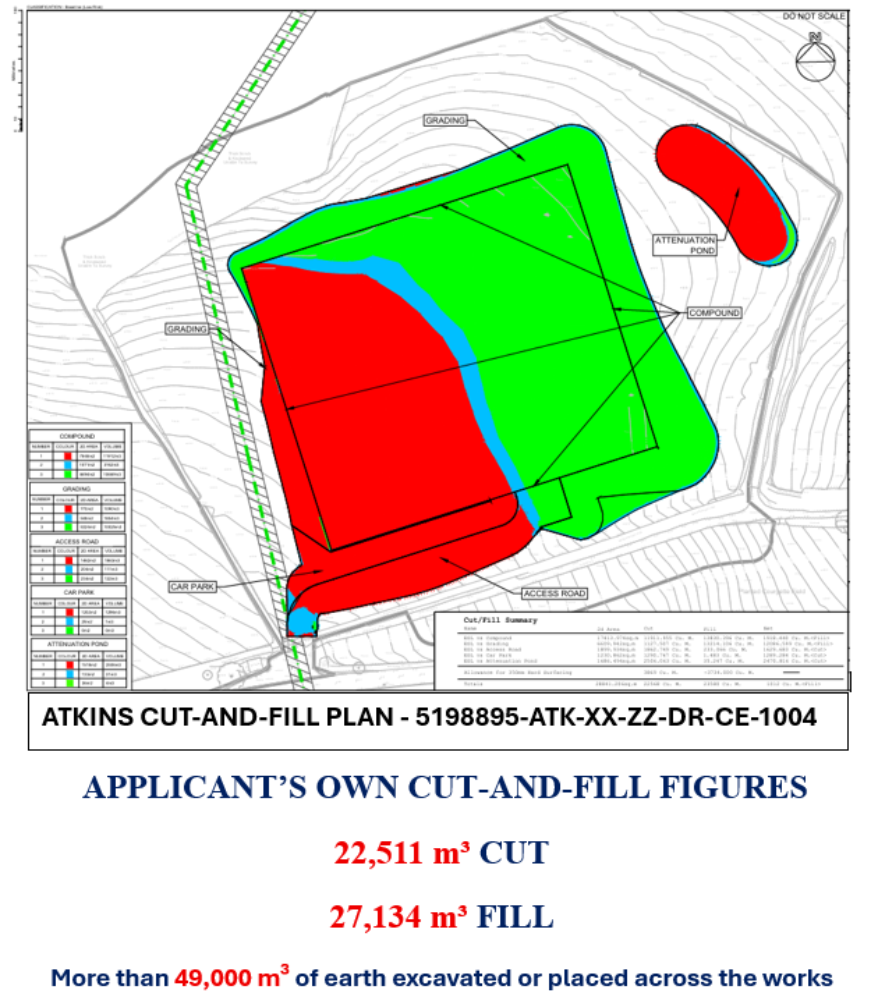
To create such a massive, level industrial platform across an area equivalent to approximately three to four football pitches, the approved development requires major cut-and-fill engineering works
Under the approved plan, soil would be excavated to a depth of around 2.5 metres from the higher western part of the site (shown in red on the plan below) and used to build up the lower eastern part (shown in green) by around 4 metres, creating a new and alien landform to support the vast concrete operating platform.
Huge volumes of earth would be excavated, moved and redistributed to manufacture an immense level surface where none exists today.
THIS IS NOT LANDSCAPING.
THIS IS NOT A MINOR REJIGGING OF GEOGRAPHY.
IT IS IRREVERSIBLE RE-ENGINEERING OF THE HILLSIDE ITSELF.
Existing ground structures, soils and drainage pathways would be cut through and rearranged across a former mining landscape where large quantities of proven arsenic and heavy metals are already documented.
Once those tainted soils have been excavated, shifted and compacted into a new landform, the original hillside cannot simply be put back.
Once cut, filled, compacted and re-engineered, recreating the original topography, soil profile and subsurface structure is impossible.
Ever.
Even though Cornwall Council has made returning the site to its former use a condition of the approval.
AND THEN COMES THE WEIGHT.
Onto that newly laid and alien landform would sit a 17,400 m² concrete processing platform.
With more than four acres of dense concrete bearing continuously down on the re-engineered hillside
Together with a 2,304 m² industrial building, large volumes of stored waste, heavy industrial machinery and constant vehicle movements.
Add tanks and ponds capable of holding up to 3.3 million litres of mainly dirty water — around 3,300 tonnes of water when full.
THE SCALE OF THE PERMANENT AND CHANGING LOADING BECOMES EXTRAORDINARY.
Yet the applicant produced no modelling of how this massive cumulative loading would affect the long-term stability and behaviour of the newly re-engineered hillside.
Or explained just how the vast concrete platform itself would be anchored to prevent movement or slippage.
These were not obscure concerns raised after the event.
Ground stability, landslip, differential settlement and the effects of imposing such immense weight on a cut-and-fill hillside were expressly raised in multiple public objections before permission was granted and not addressed by Cornwall Council.
THE QUESTION IS NOT ONLY WHAT IS DISTURBED DURING CONSTRUCTION.
But what happens afterwards as this newly created ‘Frankenstein’ landform bears the combined weight of acres of concrete, a vast industrial building, stored waste, machinery, vehicles and millions of litres of water, year after year.
CUT APART. BUILT UP. COMPACTED. LOADED.
THIS RURAL LANDSCAPE WILL BE PERMANENTLY SCARRED.