THE SITE IS APPROVED TO INITIALLY RECEIVE AND PROCESS 10,000 TONNES OF END-OF-LIFE WOOD WASTE EVERY YEAR
This is not clean, virgin timber
End-of-life wood frequently includes previously used, painted, coated, glued, preserved or treated material — carrying preservatives, residues and contaminants accumulated through its former life.
At Roseworthy, that waste would be tipped, stored, handled and mechanically shredded, generating huge quantities of exceptionally fine wood dust and airborne particles, together with a considerable noise nuisance.
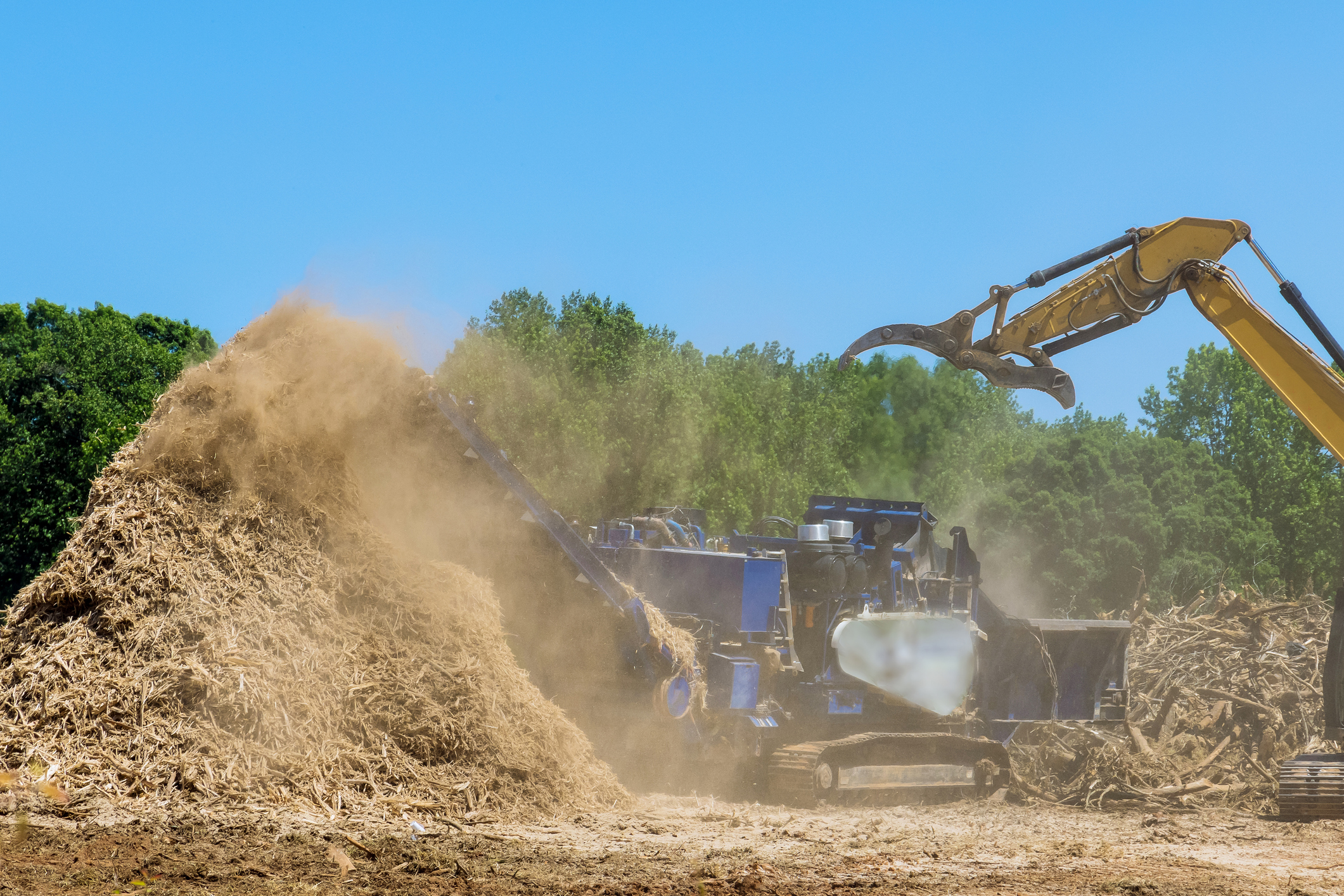
Industrial Wood Shredding (Illustrative)
Many of these wood dust particles are too small to be seen with the naked eye, yet it is the finest fraction that presents the greatest potential health concern. They can remain suspended in the air for prolonged periods, travel long distances on the wind and penetrate deepest into the respiratory system.
Despite this, no site-specific assessment has been undertaken of how these particles would actually behave at Roseworthy.
Instead, the applicant relies on generic background concentration estimates derived from Defra’s national air pollution mapping. The report itself acknowledges that the urban monitoring locations relied upon, some 60 miles away, are unlikely to be representative of this rural, windy and exposed hilltop site.
Yet those same generic data are nevertheless relied upon to conclude that the impacts at Roseworthy would be acceptable.
And where the original waste wood has been painted, coated, glued, preserved or chemically treated, the concern is not simply the wood fibre itself, but what that dust may carry with it.
And where it will go.
WOOD DUST IS NOT HARMLESS.
IT IS A RECOGNISED CARCINOGEN.
Yet despite approving the mechanical shredding of 10,000 tonnes of end-of-life wood every year, the application contains no specific operational assessment of wood shredding or the waste wood dust generated by that process.
The operational assessment considers general particulate emissions and prevailing wind conditions, but not wood shredding or the waste wood dust generated by that process as a distinct source of emissions.
More significantly, the operational mitigation measures are solely directed at the green waste composting operation.
Wood shredding and the distinct characteristics of the dust it generates are not separately addressed.
And no specific operational mitigation is proposed for wood shredding or the waste wood dust generated by that process.
ON AN EXPOSED AND WINDY HILLTOP, THE QUESTION IS NOT SIMPLY WHAT ENTERS THE SHREDDER — BUT WHAT LEAVES IT IN THE AIR AND HOW FAR IT TRAVELS. WHO OR WHAT LIES DOWNWIND?