EVERYONE KNOWS LARGE-SCALE COMPOSTING REALLY SMELLS
That isn’t controversial. It is an inevitable and unavoidable consequence of breaking down thousands and thousands of tonnes of organic waste
Sometimes the odour is faint.
Sometimes it is overpowering.
But there is always a smell.
That is precisely why specialist odour assessments are routinely prepared for composting facilities.
Local people certainly thought it mattered.
NO FEWER THAN 112 OF THE 138 OBJECTORS (81%) RAISED CONCERNS ABOUT ODOUR, NOISE OR AIR QUALITY.
In fact, objectors raised an average of more than six separate concerns each, demonstrating that odour was not an isolated complaint but one of the principal themes running throughout the public consultation.
The applicant had also already recognised this several years earlier.
For the earlier 2019 withdrawn proposal, the applicant prepared a highly detailed 2019 Odour Risk Assessment Table. This wasn’t a passing acknowledgement that compost can indeed smell.
It was a detailed operational assessment of where odours could arise throughout the site…
This assessment examined and identified, stage by stage, where malodours could be expected to arise throughout the entirety of the operation – from delivery vehicles and unloading, through shredding, windrow formation and repeated compost turning, to screening, loading and transport away from the site.
It also clearly identified residents, employees and even road users as likely receptors. It also repeatedly considered sensitive receptors at 500 metres – not simply 250 metres (the metric chosen for the 2024 application).
AFTER ALL, ODOURS DO NOT STOP DEAD AT AN ARBITRARY DISTANCE, NOR ARE THEY CONFINED BY A CONCRETE WALL.
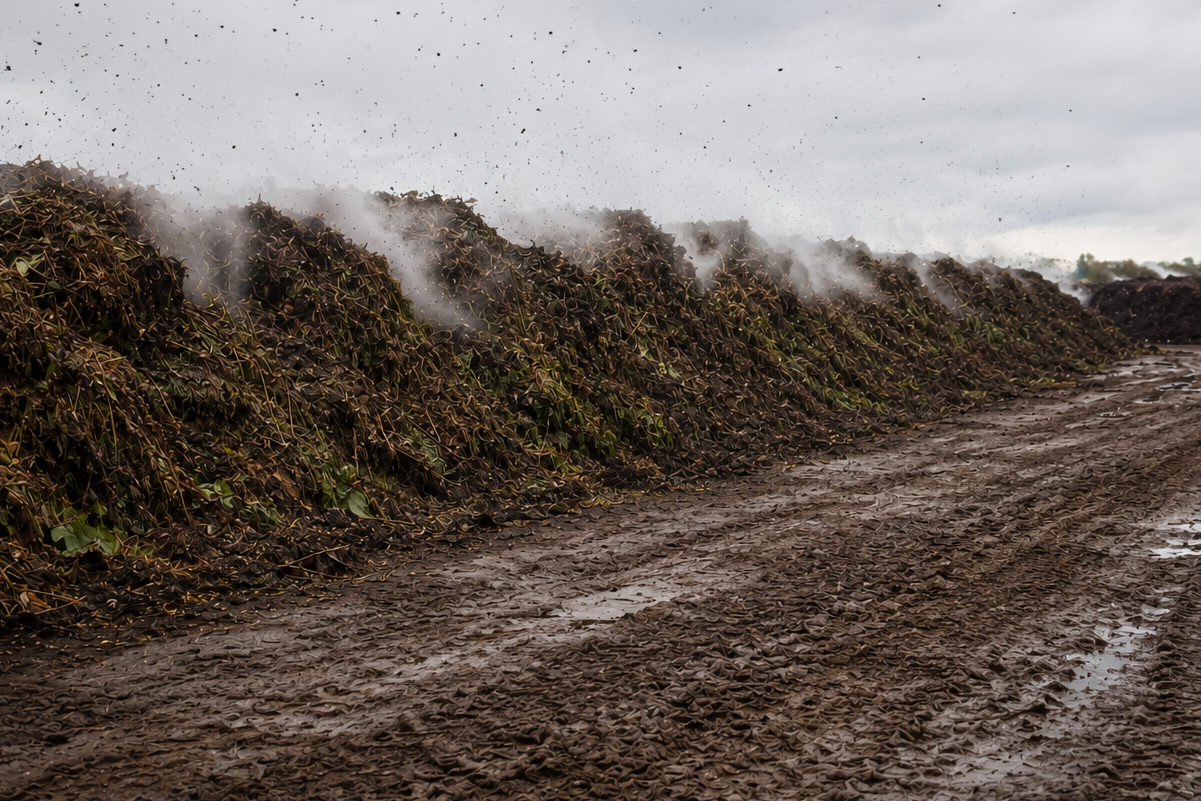
Composting green waste windrows
Yet when this much larger application came before Cornwall Council, the applicant relied upon the accompanying 2019 Bioaerosol and Odour Risk Assessment whilst not reproducing the detailed 2019 Odour Risk Assessment Table that explained where, when and how those odours were predicted to arise.
Instead, all of that operational detail was replaced by a single generic entry within the Environmental Risk Assessment, concluding there was simply “no direct pathway“.
Why? Because all receptors were more than 250 metres away.
Nor was the earlier assessment updated to consider the additional 10,000 tonnes of waste wood processing or 3,000 tonnes of agricultural plastics proposed as part of this much larger development.
This omission did not pass unnoticed.
A DETAILED OBJECTION SUBMITTED TO CORNWALL COUNCIL ON 15 APRIL 2025 SPECIFICALLY DREW ATTENTION TO THE ABSENCE OF THE APPLICANT’S 2019 ODOUR RISK ASSESSMENT TABLE.
That objection didn’t simply point out that it was missing.
- It reproduced the original table in full.
- It analysed its contents in detail.
- It explained why the evidence fundamentally altered the understanding of odour impacts presented in the current application.
- And it explicitly requested a new site-specific odour assessment.
BUT NEITHER THE MISSING TABLE NOR A NEW SITE-SPECIFIC ODOUR ASSESSMENT WAS EVER PROVIDED BY THE APPLICANT.
You can read the objection yourself by clicking the following link to the Further Info section.
Despite one of the public’s biggest concerns being odour, despite the applicant’s own earlier assessment identifying odour risks throughout the composting process, and despite Cornwall Council being specifically alerted to the missing 2019 Odour Risk Assessment Table before the decision was made:
- No updated site-specific odour assessment was ever produced.
- The applicant never supplied the missing 2019 operational Odour Risk Assessment Table.
- Odour arising from the dirty water storage ponds and attenuation pond – a well-known odour hazard – was not referred to or considered in the application.
- Cornwall Council nevertheless granted planning permission.
SO ASK YOURSELF THIS…
THE APPLICANT’S OWN EARLIER EVIDENCE RECOGNISED A FAR MORE COMPLEX AND DEFINITIVE PICTURE OF REAL-WORLD ODOUR IMPACTS…
WHY WASN’T THE APPLICANT REQUIRED TO ADDRESS THAT EVIDENCE THIS TIME ROUND BEFORE THIS DEVELOPMENT WAS APPROVED?
WHAT DOES THIS TABLE SHOW?
 Odour risks are explicitly identified by the applicant’s own consultants throughout every stage of the operational process – from the moment waste arrives on site until it leaves the site again.
The applicant’s assessment recognises numerous potential odour sources capable of operating simultaneously, creating cumulative impacts rather than isolated or one-off events.
Homes, businesses, employees and even passing road users were all identified by the applicant’s own consultants as sensitive receptors whose exposure to odour nuisance required proper and continued assessment.
The applicant’s own consultants repeatedly assessed sensitive receptors at distances of up to 500 metres from the site – not simply 250 metres, a distance widely challenged within the academic and professional community as being artificially constrained.
Yet in the current application, that more detailed 500-metre assessment disappeared and was effectively replaced by consideration of just 250 metres – half the distance assessed in the original 2019 report upon which the applicant now relies. Why?
The repeated operational controls demonstrate that effective odour management was recognised as a continual operational necessity, requiring ongoing management and intervention – not something that could be eliminated simply through site design or a procedure manual.
The table reveals that the reassuring conclusions are built upon a chain of assumptions and dependencies. They are not absolute but contingent upon numerous operational controls, management interventions and underlying assumptions continuing to hold true throughout the life of the facility. Every day. Seven days a week. 52 weeks of the year.
In other words, the predicted low risks do not arise because odour is physically prevented from occurring. They exist only because the assessment assumes that each of these operational controls, monitoring arrangements, housekeeping measures, staff training, complaint handling procedures and management interventions will function effectively whenever required throughout the life of the facility.
Every one of those measures ultimately relies upon people, systems and operational assumptions. The reassuring conclusions are therefore only as robust as the chain of assumptions upon which they depend. What happens when those controls don’t work as intended?
Despite all of this, the detailed operational assessment table disappeared from the 2024 application and was replaced by the unsupported assertion that there was “no direct pathway” for odour to reach the very receptors the applicant’s own consultants had previously identified and assessed in detail.
THE APPLICANT THOUGHT THIS DETAILED OPERATIONAL ASSESSMENT WAS NECESSARY FOR THE 2019 PROPOSAL.
SO WHY DID IT SUDDENLY BECOME UNNECESSARY FOR THIS MUCH LARGER DEVELOPMENT?