WHY I CHOSE TO ACT
This challenge began with a planning application in the valley where I live
Over more than two years, it became something much, much bigger: a question of whether serious concerns raised by ordinary people, local businesses and communities can simply be set aside when decisions with potentially irreversible consequences are made.
I wrote the following letter to explain why, as an individual, I ultimately chose to take Cornwall Council to the High Court.
A personal letter from Kim Hillier
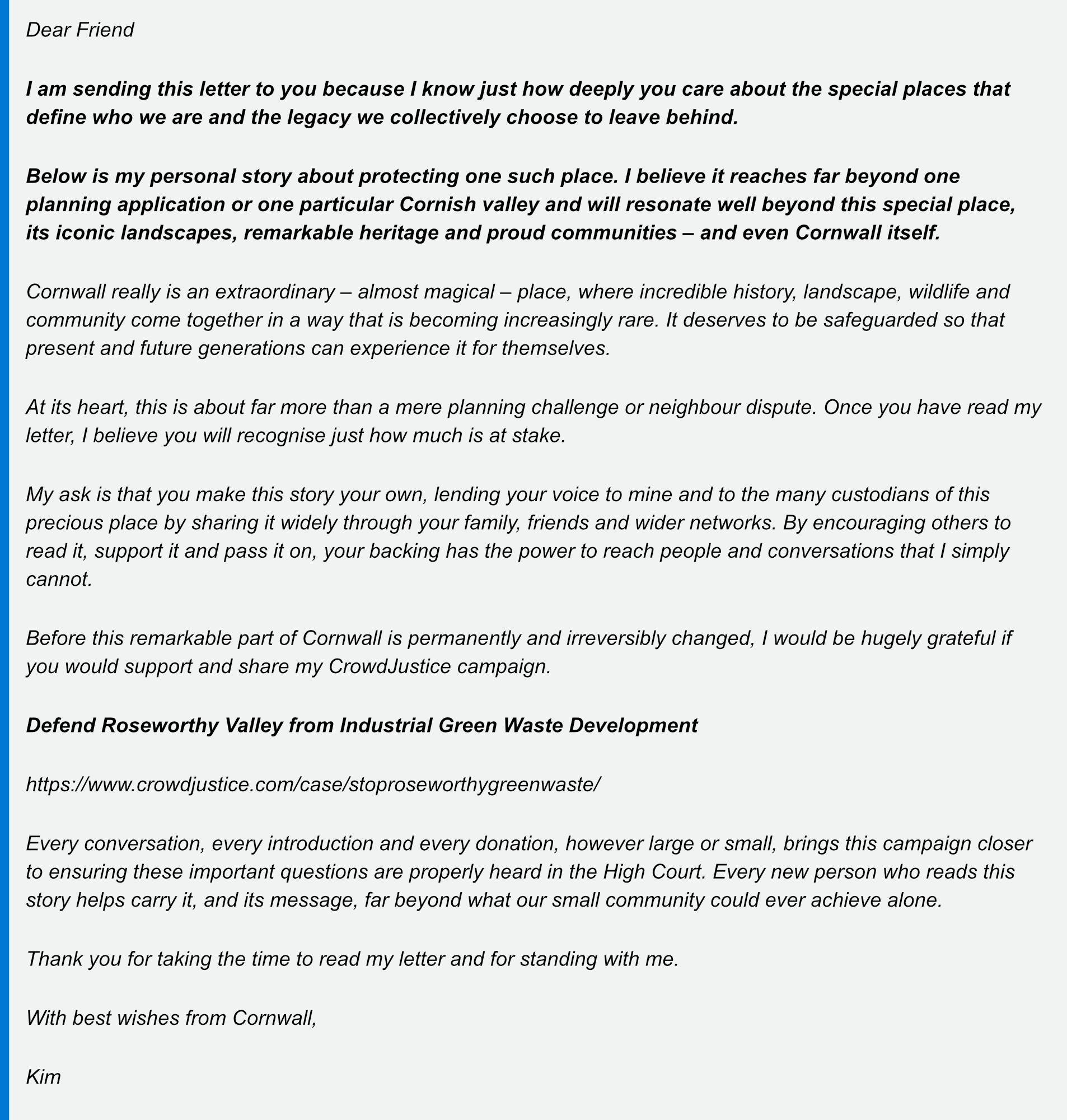
Why I Am Taking Cornwall Council To The High Court
Many of you know Cornwall intimately, having always lived here – or, like me, returned home. Others know it through family, friendships, holidays or years spent returning to the same coastline, villages and landscapes that make this part of the country so special. Still others simply share a love of its countryside, wildlife and heritage.
Like so many, I love this place and want future generations to experience its remarkable landscapes, wildlife and history as we have.
For more than two years I followed the application, submitted objections and worked alongside neighbours, farmers, local businesses and others who shared concerns about what was being proposed. Despite those efforts, Cornwall Council approved plans for a large-scale industrial green waste processing facility on open agricultural land above the Roseworthy Valley.
I couldn’t simply walk away.
The proposal would bring industrial-scale composting, wood waste processing and farm plastics recycling onto an exposed agricultural ridge at the gateway to West Cornwall.
At first glance, many people might reasonably ask:
“What’s wrong with a composting facility?”
But this is not simply another field.
It is an authentic and historic cameo of the Cornish landscape, where prehistoric heritage, mining history, productive farmland, wildlife and communities continue to exist as part of a living whole.
It sits within a natural buffer between four Sites of Special Scientific Interest, surrounded by productive farmland, communities and important wildlife habitats. Sensitive watercourses rise within, beneath and around the site before flowing downhill through the valley into the Red River and ultimately to the protected waters of St Ives Bay, overlooked by the iconic Godrevy Lighthouse and forming part of one of Cornwall’s most celebrated coastal landscapes.
It is the principal approach to West Cornwall – the landscape that welcomes millions of people travelling towards Hayle, St Ives, Penzance and Land’s End.
It is also a landscape of extraordinary heritage. Carn Brea, one of Cornwall’s earliest known prehistoric settlements and one of its most iconic landmarks, commands panoramic views of the site and surrounding landscape from over five miles away, where the proposed industrialisation of this exposed hillside would become a permanent part of its historic setting. Nearby stands the Roseworthy Arsenic Works, a Scheduled Monument believed to be the only surviving arsenic works in Cornwall to retain both its chimney and underground chambers. It played its part in making Camborne “the richest square mile in the world” during the Industrial Revolution and helped shape the unique mining landscape whose significance is today recognised through the internationally renowned Cornwall and West Devon Mining Landscape World Heritage Site, drawing people from across the world to experience Cornwall’s rich heritage.
For me, this is not an abstract planning dispute.
It is home.
It is the landscape I see every day, the countryside I walk and the historic environment I care deeply about. I know where the streams flow after heavy rain. I know how this valley connects farmland, wildlife, heritage and the coast. I also know that once an exposed hillside is excavated, engineered and transformed into an industrial green and end-of-life wood waste processing site, there is no going back.
That is why this case is about so much more than a single planning application.
Nor is it about whether composting is a good thing. Green waste should be recycled and reused wherever possible. This case is about whether a major industrial waste processing facility belongs in this particular location – above connected watercourses, productive farmland, historic landscapes and local communities that together define the gateway to West Cornwall.
It is about historic mining and arsenic contamination and the movement of water through the catchment. It is about agriculture, ecology and protected landscapes. It is about internationally important heritage and the irreversible scarring of an open hillside. It is about the permanent industrialisation of the principal agricultural corridor leading into West Cornwall.
These are not separate issues.
They are connected because this landscape is connected.
Water does not stop at boundaries. Wildlife does not recognise planning application lines. Heritage is experienced as a living landscape rather than isolated monuments. Once open countryside is buried forever beneath concrete and industrial infrastructure, the change is permanent.
That is why I could not simply walk away.
The High Court has already considered the legal challenge and concluded that there is an arguable legal case on multiple grounds, initially granting permission on four of them. It has since ordered that my renewed application for permission on the remaining two grounds be adjourned to be determined after a rolled-up hearing. If permission is granted on those grounds, the Court will proceed immediately to determine them as part of the substantive claim. The substantive hearing is listed for 1 and 2 December 2026. As a result, all six grounds of the legal challenge may now come before the High Court during the December hearing.
I believed these questions mattered enough to take to the High Court, so I funded the early stages of the judicial review myself. I wanted an independent Judge to decide whether there was a case to answer before asking anyone else to stand with me.
Cornwall’s landscape has been shaped over thousands of years. A planning decision made in a matter of hours has the potential to alter part of it forever. If this exposed hillside is excavated, engineered and industrialised, there is no going back, and a permanent precedent for further industrialisation will have been set throughout the entire valley.
Some places are simply too important to get wrong.
Today, I am asking you to become a custodian of this extraordinary Cornish landscape.
Your donation will help fund the challenge. Your voice will help carry it further. Your willingness to share this story may inspire someone else to act.
Every conversation, every introduction, every repost and every contribution gives this campaign new energy and a wider reach.
Together, we can ensure that these important questions are answered before irreversible change takes place and that future generations inherit this remarkable landscape, rather than one day watch documentaries about the places we failed to save.
You have the power to make a genuine difference.
The future of this remarkable landscape is not yet written.
Together, we still have the opportunity to shape it.
Please help me write its next chapter.
Kim